
Vol 37-Monthly Disaster Outlook

MONTHLY DISASTER REVIEW OUTLOOK
MARCH 2018 | DISASTER MONITORING & ANALYSIS
(DMA) UNIT, AHA CENTRE


GENERAL OVERVIEW OF MARCH 2018
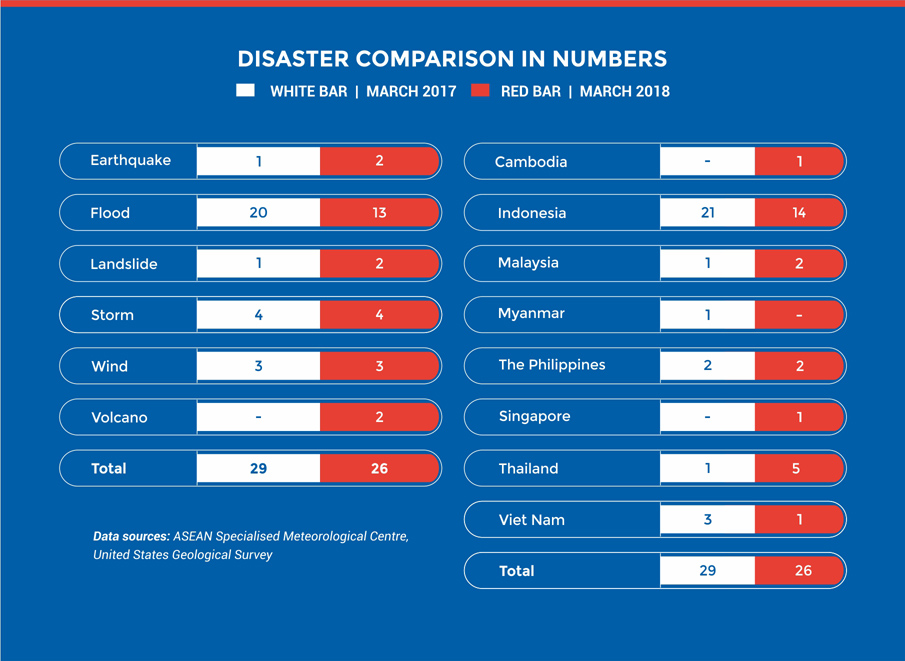
Hydro-meteorological disasters, particularly floods, strong winds and storms, continued to dominate disaster occurrence figures in March 2018. During the month, flash-flooding events due to extreme rainfall within a short amount of time, occasionally triggering landslides as a secondary disaster, as evident in several events across Indonesia. Localised strong winds and storms caused damage in Cambodia, Singapore, Thailand and Viet Nam.
In terms of geological hazards, moderate-to-strong earthquakes (≥ M 5.0) were observed in Indonesia, Malaysia and the Philippines, triggering minor local disruptions without having a significant impact on communities. The ASEAN Earthquake Information Center (AEIC) recorded four earthquakes with a magnitude stronger than M 6.0, three of these-originating in Papua New Guinea – were felt as far across as the Papua Province of Indonesia. Volcanic activities of Mount Mayon in the Philippines continued to affect more than 90,000 people in the nearby Albay Province. On Mount Sinabung, Mount Ijen and Mount Dieng (in East and Central Java provinces Indonesia), toxic gas releases were recorded, and while there were no significant eruptions, the release on Mount Ijen prompted a mandatory evacuation of local communities.
OUTLOOK FOR APRIL-MAY 2018
According to the ASEAN Specialised Meteorological Center (ASMC), the April-May 2018 season can expect slightly below-normal to near-normal rainfall. This is forecasted for most parts of Southeast Asia, except the Philippines. During April 2018, slightly above-normal rainfall is forecast over the northern regions of Kali-mantan and Sulawesi, and western parts of Papua in Indonesia. Towards May 2018, slightly below normal rainfall is expected for most parts of Kalimantan (Indonesia, Malaysia and Brunei Darussalam), Sumatra, Java, Bali and the Nusa Tenggara archipelago of Indonesia. ASMC also stated that there is around 60% chance of La Niña conditions lasting until to end of April 2018, and then a return to neutral conditions during May.
Indonesian Centre for Volcanology and Geological Disaster Mitigation PVMBG states that for April 2018, areas in western Sumatra, south of central Java, north-eastern Borneo, eastern Sulawesi and northern Papua will be prone to ground movement inducing, landslide events. Continuous monitoring for potential humani-tarian consequences will also be required due to the activity of Mount Sinabung (‘PVMBG’s arlet level: warning) and Mount Agung (‘PVMBG’s arlet level: watch) in Indonesia, as well as Mount Mayon and Mt. Kanlaon (PHIVOLCS’ alert level 2, – moderate level of unrest) in the Philippines. Moderate-to-strong earthquakes are still expected in the bordering region between Papua (Indonesia) and Papua New Guinea.
Written by : Mizan Bisri, Qing Yuan Pang
DISCLAIMER
AHA Centre’s estimation is based on data and information shared by National Disaster Management Organisations (NDMOs) and other relevant agencies from ASEAN Member States, international organisations and news agencies. Further information on each recorded-significant disaster, description and details of data and information are available at: http://adinet.ahacentre.org/reports.
- Published in Monthly Disaster Outlook
Vol 38-Monthly Disaster Review and Outlook
MONTHLY DISASTER REVIEW AND OUTLOOK
APRIL 2018 | DISASTER MONITORING & ANALYSIS
(DMA) UNIT, AHA CENTRE

GENERAL OVERVIEW OF APRIL 2018
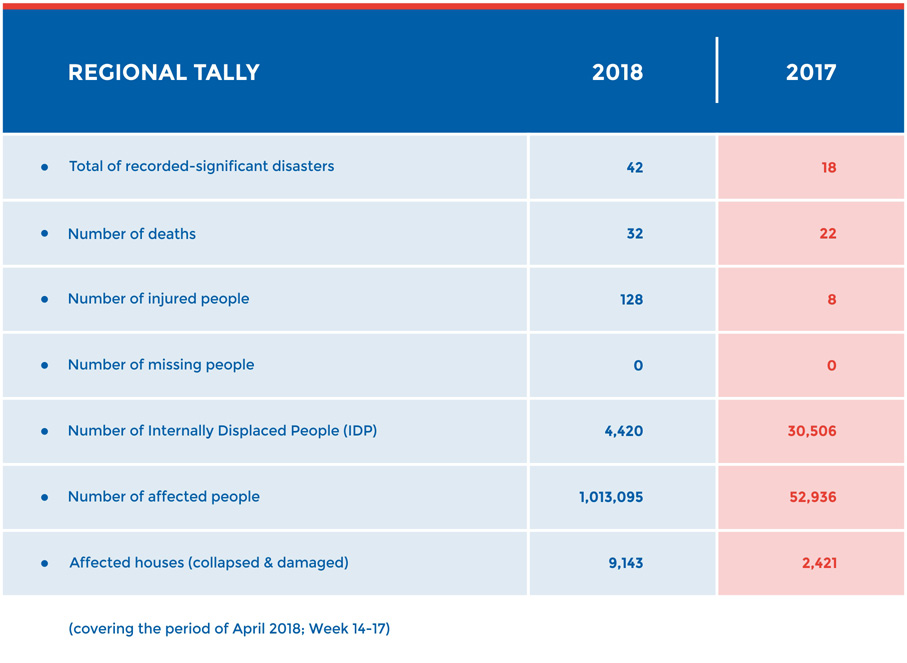
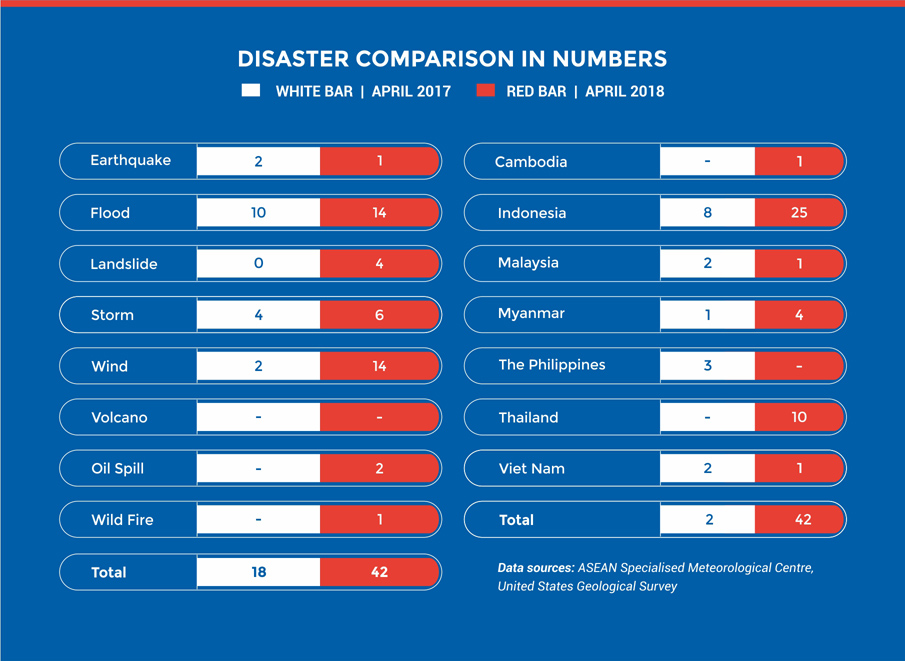
Flood and wind-related disasters had by far the highest number of occurrences during April 2018. ASEAN should remain prepared as changes in seasonal and weather patterns occur, increasing the probability and varying impact of hydro-meteorological disasters. According to the ASEAN Specialised Meteorological Centre (ASMC), the northern ASEAN region continued through its traditional dry season, while wetter conditions were experienced in the south of the region, as the monsoon through and its associated rain-band settled close to the Equator. Hailstorms were a notable phenomenon last month in Lao PDR and North-Eastern Thailand, resulting in adverse impacts on power lines, infrastructure and agriculture.
22 moderate-to-strong earthquakes (> M 5.0) were observed across Indonesia, Myanmar and the Philippines during the month, causing minor disruptions locally, but without significant humanitarian impact. One notable event was the M 4.4 earthquake reported in Banjarnegara, Indonesia, with the shallow quake centre and the area’s loose soil conditions causing severe damage to 465 houses (57.8% suffered partial to total collapse).
Technological disasters also took place during April, most notably a range of landfill fires in Myanmar that threatened the health and livelihoods of significant numbers of residents in nearby areas. Significant numbers of people were affected by fumes resulting from these fires, with residents living close to the landfill site experiencing the worst conditions. Starting on the 21st of April, smoke from the fires covered 20 townships across Yangon, with an increased likelihood of adverse health effects – particularly for children and the elderly – experienced by almost 800,000 people within a 30 km radius of the fires.
OUTLOOK FOR MAY-JUNE 2018
The region is expected to gradually transition from the current Northeast Monsoon conditions, to the inter-monsoon conditions in May 2018 – in which low-level winds in the region are generally light and variable in direction, with an increase in shower activities to be expected. Some parts of the northern ASEAN region may continue to experience dry conditions in May 2018, but are likely to ease off with an increase in shower activities as the inter-monsoon period takes hold. For the southern ASEAN region, shower activities are expected over most parts of the area.
For the rest of the April-May-June 2018 season, the northern ASEAN region is likely to experience near-normal rainfall levels, aside from coastal areas of the Andaman Sea and the Philippines, where there is an increased chance of above-normal rainfall. In the southern ASEAN region, slightly below-normal to near-normal rainfall can be expected.
Written by : Mizan Bisri, Qing Yuan Pang
DISCLAIMER
AHA Centre’s estimation is based on data and information shared by National Disaster Management Organisations (NDMOs) and other relevant agencies from ASEAN Member States, international organisations and news agencies. Further information on each recorded-significant disaster, description and details of data and information are available at: http://adinet.ahacentre.org/reports.
- Published in Monthly Disaster Outlook
Vol 39-Monthly Disaster Review and Outlook
MONTHLY DISASTER REVIEW AND OUTLOOK
MAY 2018 | DISASTER MONITORING & ANALYSIS
(DMA) UNIT, AHA CENTRE
GENERAL OVERVIEW OF MAY 2018
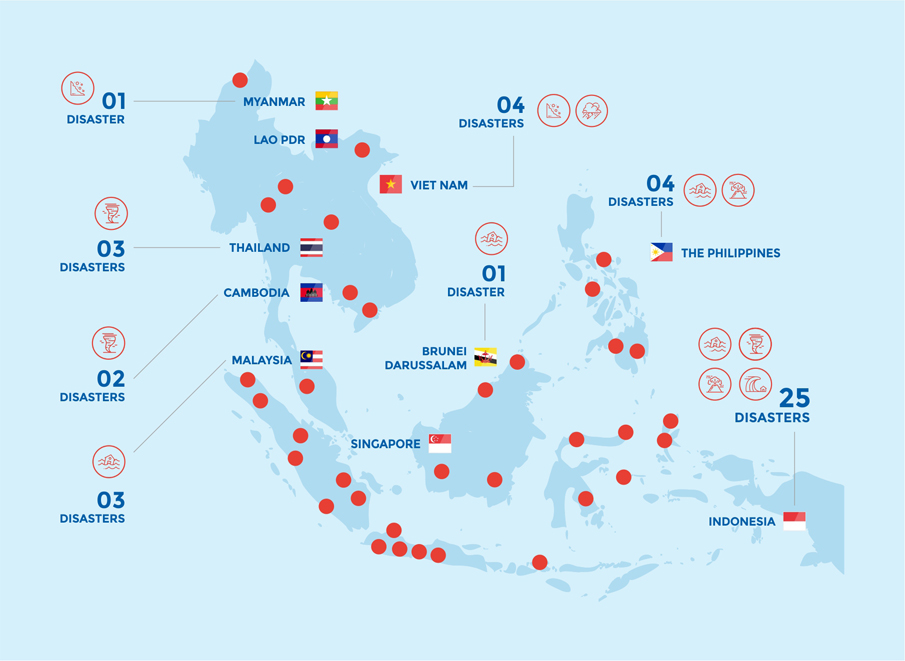
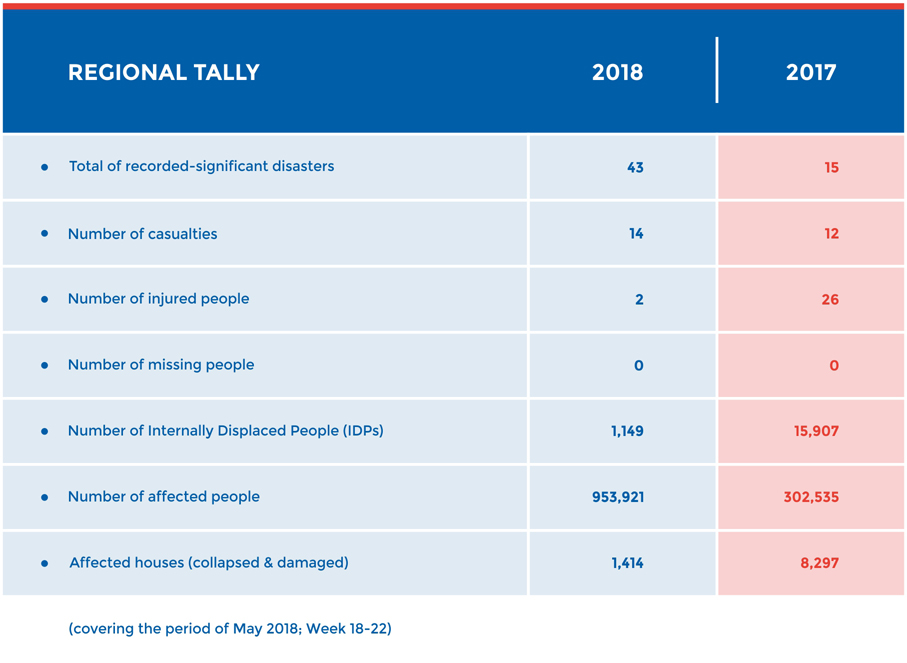
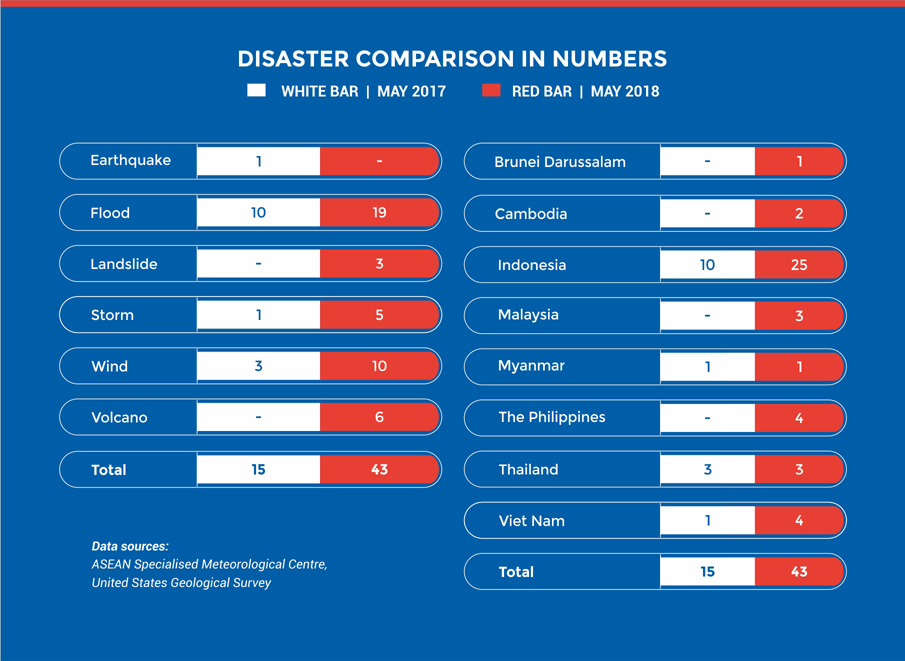
Hydro-meteorological hazards continued to form a majority of disasters within the ASEAN region during May 2018. Using yearly data comparisons, it is evidenced that the ASEAN region experienced twice as many disasters when compared to the same time period last year. Data for the initial three weeks of the period showed low numbers of recorded disasters. However, numbers increased significantly as Tropical Depression 5 developed and moved across Sulu Sea and into the South China Sea. This situation resulted in flooding, storm surges and strong wind events across Indonesia, the Philippines, Malaysia, Brunei Darussalam and Viet Nam. Monsoon season has begun in areas within proximity of the Indian Ocean, which creates increased flood risks for northern Myanmar along the Irrawaddy basin. This is consistent with ASEAN Specialised Meteorological Centre’s (ASMC) observation of the end of the dry season on the 16th of May, marked by an increase in shower activities across the northern part of the ASEAN region.
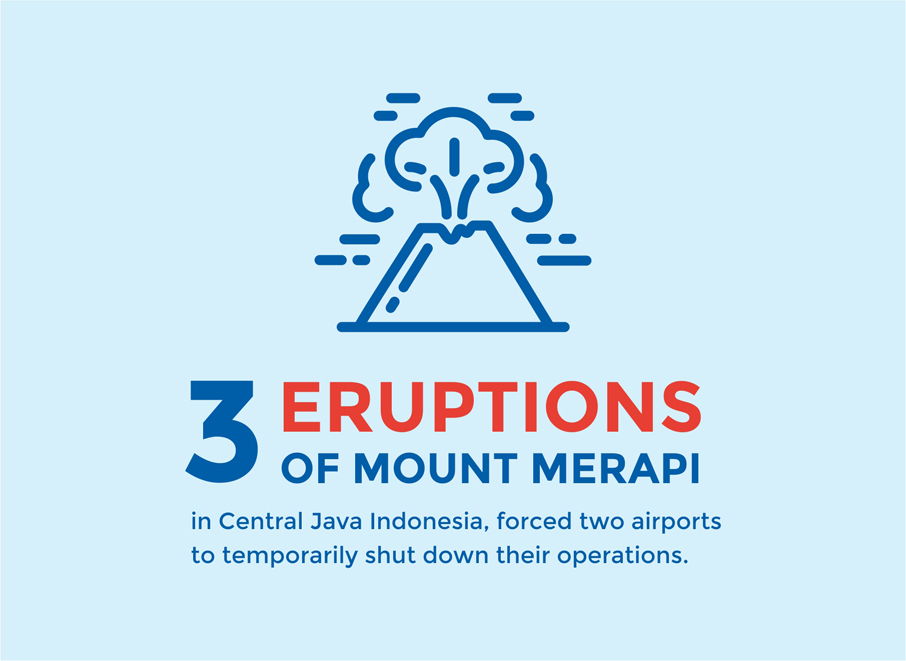
There were 37 moderate earthquakes with magnitudes of > M .4.0 felt in Indonesia and the Philippines, which were observed at around II to IV MMI. Despite the magnitude of such events, no casualties or damage was reported as a result of earthquakes in both countries. As of the end of May, the alert status for volcanoes in Indonesia are as follows – Warning Alert (Awas, the highest of 4 levels) for Mount Sinabung in North Sumatra; Watch Alert (Siaga, second highest) for Mount Agung in Bali; and Cautionary Alert (Waspada, a level 3 alert) for 19 other volcanoes across the nation. Despite its Cautionary alert level, Mount Merapi in Central Java, Indonesia, has experienced significant increased activity recorded on the mountain, with phreatic eruptions and release of volcanic ash columns beginning on the 21st of May. Three eruptions at the end of Week 22 (1st of June 2018) forced two airports in Central Java to temporarily shut down their operations as a result of the ash plume.
OUTLOOK FOR JUNE-JULY 2018
According to the ASMC, wet weather conditions are expected over the northern parts of the ASEAN region for the rest June, with more shower activities forecast as the transition to the Southwest Monsoon is expected to begin during the month. Rainfall can be expected to increase during this time due to the presence of the monsoonal rain band across the north of the ASEAN region. The Southwest Monsoon season typically prevails over the region between June and October, and is associated with the traditional dry season in southern parts of ASEAN contrasting with the wet season in northern parts of the ASEAN region.
In stark contrast to the northern ASEAN region, extended periods of dry weather can be expected during June and July in the southern reaches of ASEAN. This may lead to an escalation of hotspot activities, with smoke plumes should ignition occur, particularly in parts of Sumatra and Kalimantan. Slightly below-normal to near-normal rainfall may still occur over most parts of the region during this period, with below-normal to slightly below-normal rainfall expected for Java, Nusa Tenggara and Timor Leste during the early part of the Southwest Monsoon season.
As always, you should keep posted on weather updates from your respective Meteorological Services and Disaster Management Organisations for evacuation notices (if any). You can refer to our social media for links to the respective national agencies and organisations for further information.
Written by : Mizan Bisri, Qing Yuan Pang
DISCLAIMER
AHA Centre’s estimation is based on data and information shared by National Disaster Management Organisations (NDMOs) and other relevant agencies from ASEAN Member States, international organisations and news agencies. Further information on each recorded-significant disaster, description and details of data and information are available at: http://adinet.ahacentre.org/reports.
- Published in Monthly Disaster Outlook